
The following article is a sponsored post.By Shane RobertYou dont need hours in the gym to build strength and support your bones.You need the right kind of training, a sensible plan, and a way to make it fit your life.A bone density scan can leave you with more questions than answers.If the results show bone loss, your doctor may suggest weight-bearing exercise.
But what does that look like day to day? Is walking enough? And if your bones are already thinning, is lifting weights a smart move or a risk?That last worry is common.Many of us picture heavy lifting as something for young athletes, not women in their 50s and 60s.But research suggests that the right kind of strength training can play a real role in keeping bones healthy at any age.Your Bones Respond to DemandBone is living tissue.
Your body is always breaking it down and building it back up, and it adapts to the work you ask of it.After menopause, falling estrogen speeds up bone loss, which is one reason older women face a higher risk of osteoporosis and fractures.Exercise gives your bones a reason to stay strong.Walking is great for your heart, mood, and mobility.
But bone tends to respond best to activities that load it more than everyday life does, such as impact exercise and strength training that gets gradually harder over time.None of this means you need to pick up heavy weights tomorrow.It means the right level of challenge matters, and that low bone density isnt automatically a reason to avoid strength training.What One Well-Known Study FoundThe LIFTMOR trial, run by researchers in Australia and published in 2018, followed 101 postmenopausal women with low bone mass, averaging about 65 years old.Half did a supervised program of heavy lifts, including squats, deadlifts, and overhead presses, plus a jumping exercise.
The other half did a gentler home routine.The supervised group trained just twice a week, for about 30 minutes a session, over eight months.They started light and built up gradually under the eye of trained instructors.The results were encouraging.Bone density in the lower spine rose by about 2.9% in the lifting group, while it dropped about 1.2% in the home-exercise group.
Hip bone density held steady in the lifters and declined in the comparison group.The lifters also improved on tests of physical function.Only one minor injury was reported, a muscle spasm in the lower back.It was a fairly small study, and the women were carefully screened and closely supervised.
So it doesnt mean everyone with low bone density should start heavy lifting on her own.What it does show is that, with good instruction and gradual progress, women at this stage of life may be able to handle more challenge than many people assume.The Hard Part Is Often Finding the TimeTwo short sessions a week sounds doable.Often the problem isnt the workout.
Its everything around it.A 30-minute gym session can easily eat up an hour or more once you add driving, parking, changing, and waiting for equipment.For anyone juggling work, family, and caregiving, those extra steps can be enough to push exercise off the calendar.Training at home removes many of those hurdles.You can work out before the day starts, on a break, or in the evening without leaving the house.
A good gym and a skilled coach are still excellent resources.But the best program is the one youll actually follow, and convenience helps.A Home Gym That Fits Your SpaceA home gym doesnt have to mean a garage full of equipment.Resistance bands and adjustable dumbbells work well in small spaces and cover squats, rows, presses, and more.
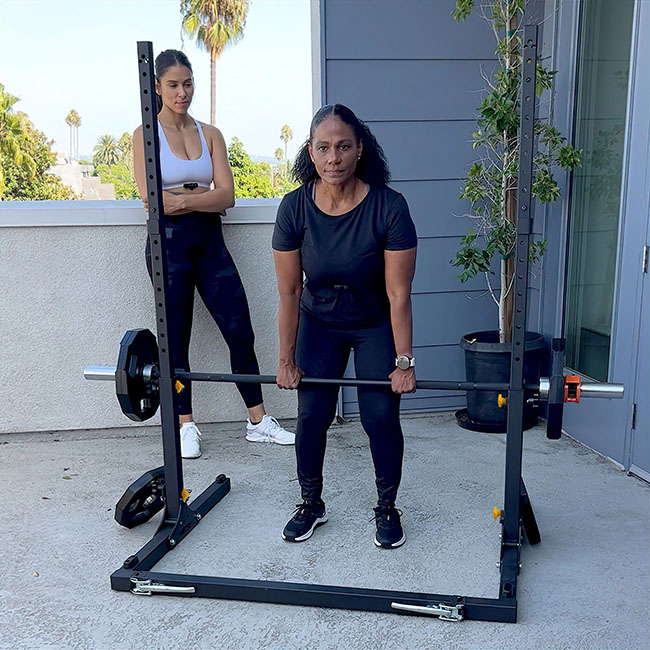
If you want to move toward barbell training, youll need a rack, a bar, weight plates, and a bench.Think about storage space and the clear space you need to lift safely.Nannette, 57, has been strength training for more than 30 years.When the Verse Fitness team asked her to try the Agile Rack, a freestanding squat rack that folds away between workouts, she set it up on her balcony.At first when we were putting it together, I was like, okay, this doesnt look like its that sturdy, she says.
Once we put it up, I said, wow, this is pretty sturdy equipment.But it wasnt heavy.Its very streamlined and it doesnt take up a lot of space.Its not just a little dumbbell workout, Nannette says.
This is the real deal, right in your house.Whatever you use, follow the makers instructions and learn how to use the safety features, especially if you train alone.If youre new to barbell lifting, learn the movements from a qualified professional before you add serious weight.How to Get Started SafelyIf you have low bone density, talk with your doctor before you begin.Ask what kinds of strength training are right for you, especially if youve had fractures, back pain, or balance problems.A physical therapist or a strength coach who works with older adults can help you choose exercises, learn good form, and build a plan that matches where you are now.
Start with weights you can manage and focus on moving well.As you get stronger, add a little more challenge over time.This gradual approach is how the women in the LIFTMOR study built up safely.Two sessions a week is a reasonable goal for many people, though your plan should reflect your own health and your providers advice.What Getting Stronger Makes PossibleFor Nannette, training isnt about lifting a heavier barbell.
Its about staying able to do the things she loves.My goal is to remain active and independent, to do all the things I envision myself doing at this stage of life, she says.Being able to do things on my own, be able to hang out with the younger kids and be able to run around with my goddaughter.She also knows training changes with age.Once you reach a certain age, I believe the muscles just need a little bit more tender loving care, a little bit more attention.That attention pays off in the things you want to keep doing: carrying your own bags, climbing stairs, getting up off the floor, and playing with the grandkids.
Strength training cant promise youll never break a bone.But it can build strength, help you move better, and give your bones a reason to stay strong.If youve been told your bone density is low, you dont have to choose between doing nothing and taking big risks.Get good guidance, learn to train safely, and build from there.
You may find the hardest part isnt the lifting.Its making it easy enough to keep showing up.Shane Robert is a strength coach and the co-developer of the Agile Rack at Verse Fitness.He writes Verses training content and hosts its podcast and YouTube channel with over 100k subscribers.
More information @verse.fitnessSPONSORED BY:
Disclaimer: This story is auto-aggregated by a computer program and has not been created or edited by Senior Savings Deals.
Publisher: Healthy Aging ( Read More )
Publisher: Healthy Aging ( Read More )